A Tribute from the Workbench

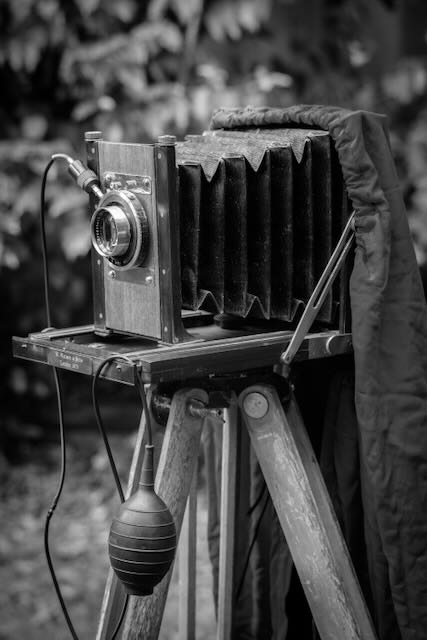
In the early years of photography, cameras were heavy, slow, and difficult to carry into the real world. For Oskar Barnack, an avid traveler whose health made carrying massive gear increasingly difficult, there had to be a better way.

As a precision engineer at Ernst Leitz in Wetzlar, Barnack spent his days perfecting microscopes, but his side project was far more radical. He looked at 35mm movie film and had a stroke of genius: he turned the film on its side. By running it horizontally, he doubled the frame size to 24×36mm, creating the still-photo frame size that remains a standard to this day.
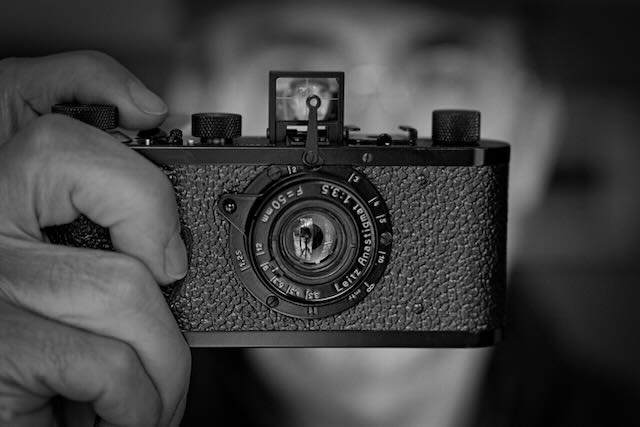
Barnack approached photography with the mind of a problem solver and the hands of a craftsman. In 1913, he built his first working prototype. He nicknamed it “Lilliput,” a nod to the tiny people of Gulliver’s Travels, because compared to the giant plate cameras of the era, his invention seemed impossibly small. He worked closely with Max Berek, Leitz’s lens expert, to ensure that the tiny negatives could be enlarged into sharp prints. This was the birth of modern handheld photography.
The true test came not in a laboratory, but in disaster. In 1913, severe flooding struck Wetzlar, and Barnack used his small prototype to document the devastation. While others struggled with bulky equipment, he was able to move freely through the streets, capturing scenes that would have been nearly impossible with the cameras of the day. Those images proved that his little camera was not just clever engineering, but a practical tool for real life.
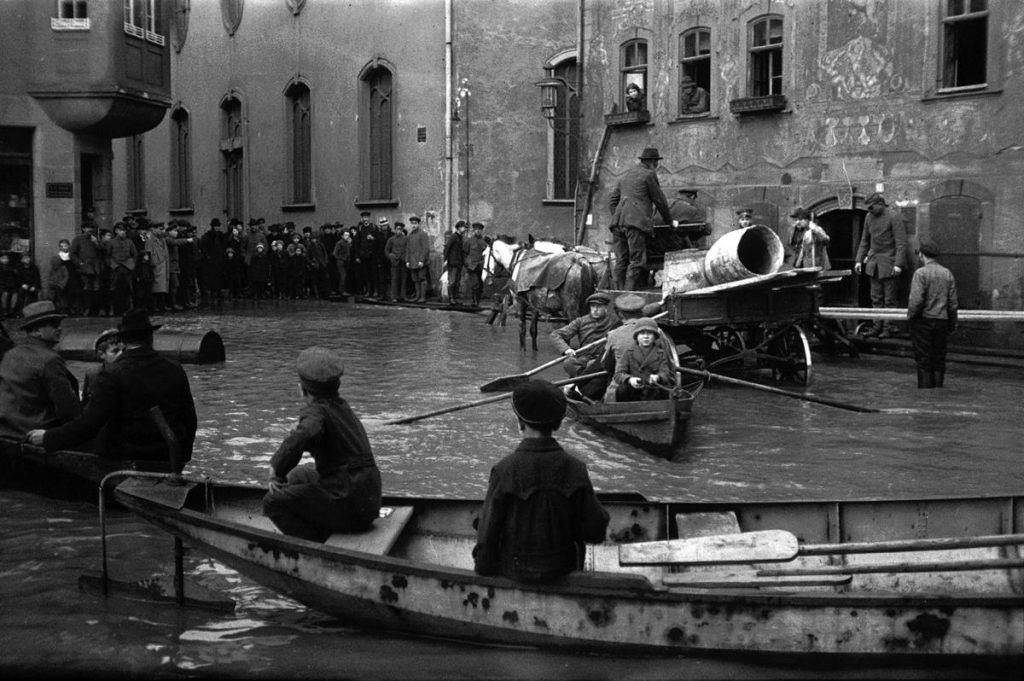
However, an invention needs a champion. His boss, Ernst Leitz, was a visionary who recognized the potential of the “Lilliput” and even took a prototype to New York in 1914 to test it himself, photographing the city’s skyscraper canyons.
The First World War delayed production for a decade, and by 1924, Germany was in economic ruin. Most of Leitz’s advisors told him to kill the project, fearing it was too risky to launch a new camera format during a depression. But Leitz saw a way to keep his factory workers employed and change the world. In a legendary board meeting, he ended the debate with one sentence:
“Ich entscheide hiermit: Es wird riskiert.”
(“I hereby decide: the risk will be taken.”)
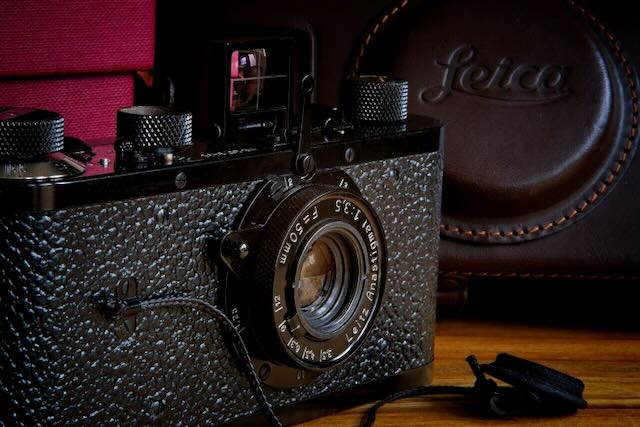
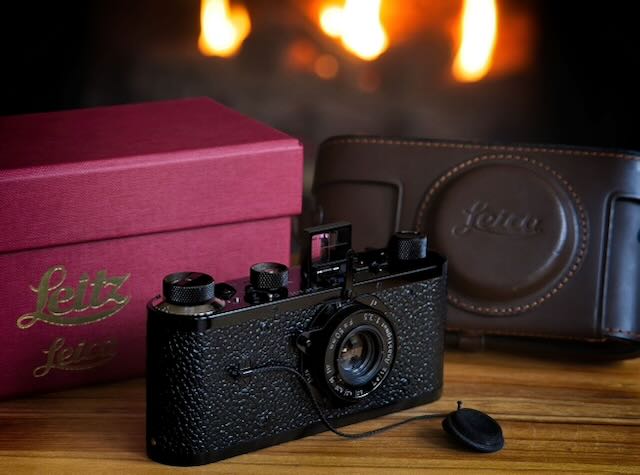
With the decision made to go to market, the “Lilliput” needed a professional name. They combined the first three letters of the owner’s name (Leitz) with the first two letters of the word camera. And just like that, the Leica was born.
When the Leica I finally reached the public in 1925, it changed the direction of photography forever. Photojournalists and everyday storytellers finally had the freedom Barnack had imagined at his workbench.
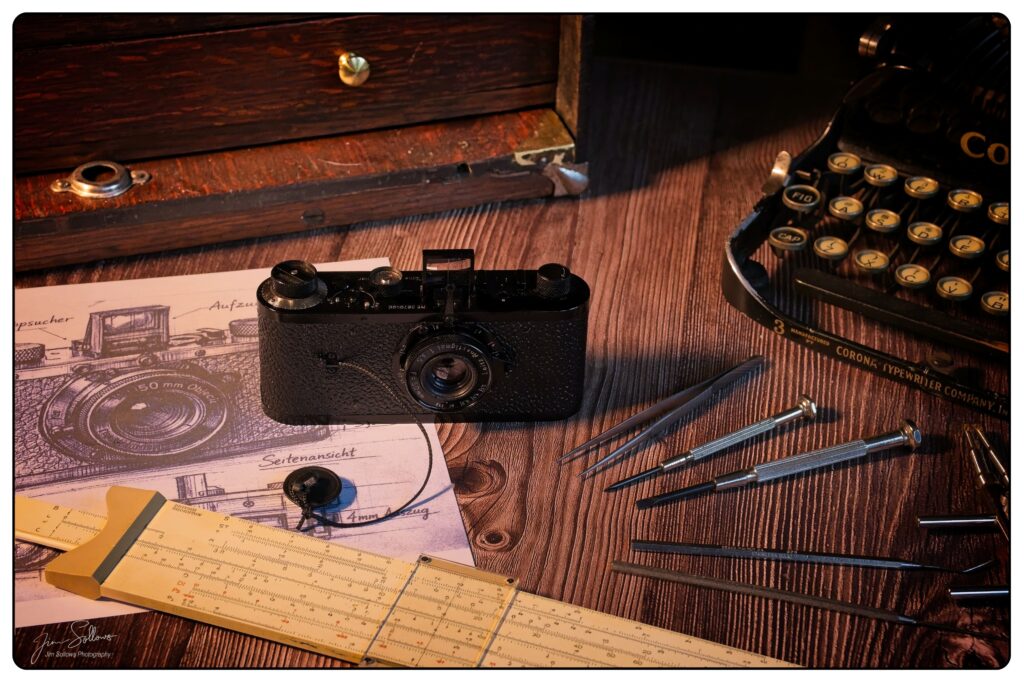
The image above is my tribute to that moment. The Leica 0 sits on a blueprint that echoes the engineering sketches of the prototype camera design. The tools surrounding it reflect the world Barnack and Leitz inhabited—a world where precision and imagination worked side by side.
Barnack didn’t just design a camera, and Leitz wasn’t merely a businessman. Together, they created a tool that sparked a revolution in photography. Every shutter click carries a trace of their original vision.