Bringing a Baby Graflex Back to Life

Some repairs feel purely mechanical. Others feel like opening a small door into the past. Replacing the ground glass on a Baby Graflex press camera — a compact little workhorse from the 1930s — sits squarely in the second category. These cameras were built for speed and clarity in an era when photography was still equal parts craft and improvisation, and their focusing screens were the quiet heart of that workflow. When the glass breaks, the camera doesn’t just stop functioning; it loses its voice.
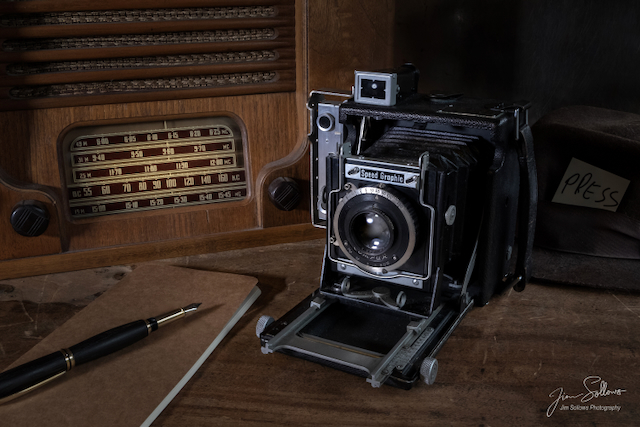
49184544336 9564229c20 o

In this story, I walk through the process of fitting a new ground glass into a camera that has already lived several lifetimes. It’s a simple repair on paper, but one that rewards patience, precision, and a bit of reverence for the people who once relied on this machine. 

The focus screen on these old cameras is a special piece of ground glass that sits the same distance from the lens as the film. The photographer can use the ground glass to focus the camera and when it’s ready the film sheet is slid into position to capture the image.

In this camera, somewhere over the past 90 or so years, the ground glass became damaged. 
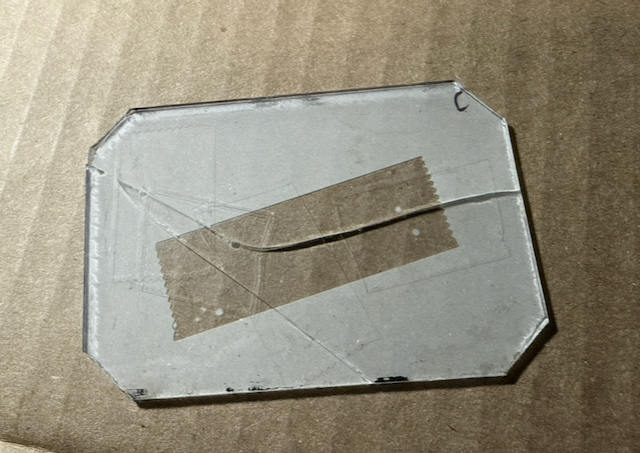
IMG

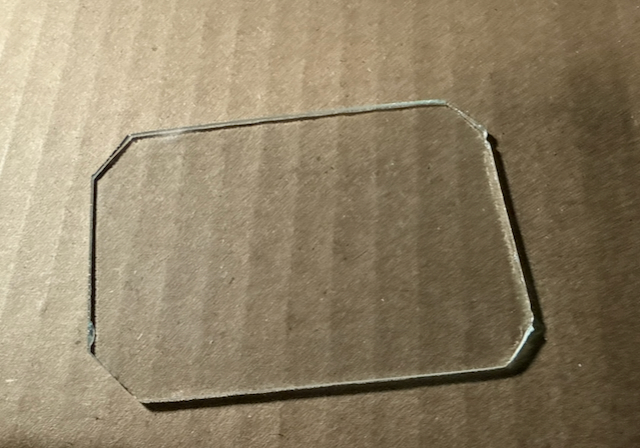
Today we will fix that! We start by cutting a new piece of glass to size and shape.
IMG

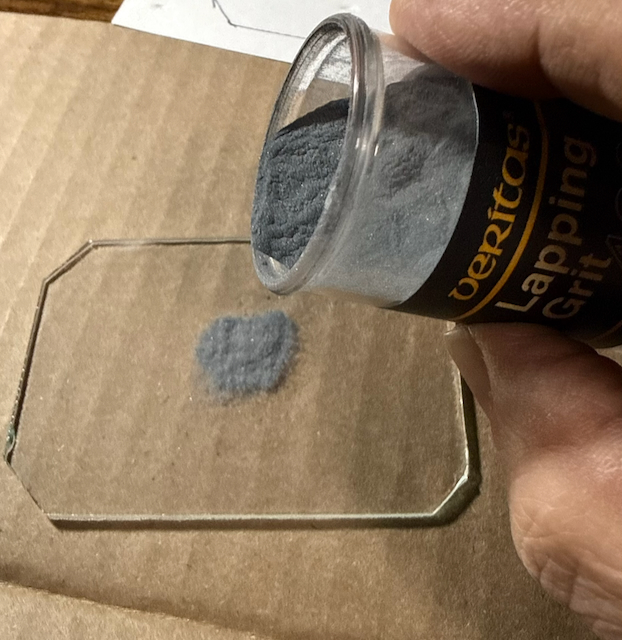
Of course, a plain piece of glass won’t work — light would simply pass straight through. The side facing the lens needs to be etched so it can act as a surface for the image to form. I start with an extremely fine diamond grit.
IMG

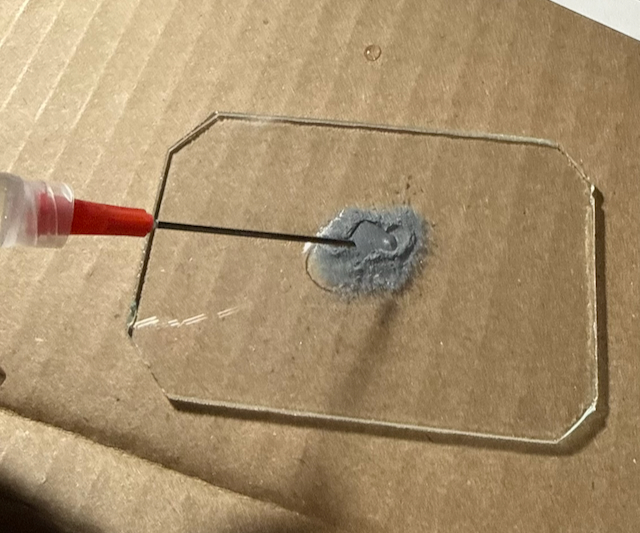
A bit of water turns the grit into a slurry.
IMG

The slurry is then sandwiched between the new glass and another plate of glass attached to a handle. With steady pressure and a circular motion, the grit slowly grinds the surface. Over time, the new glass takes on an even, matte texture.

IMG

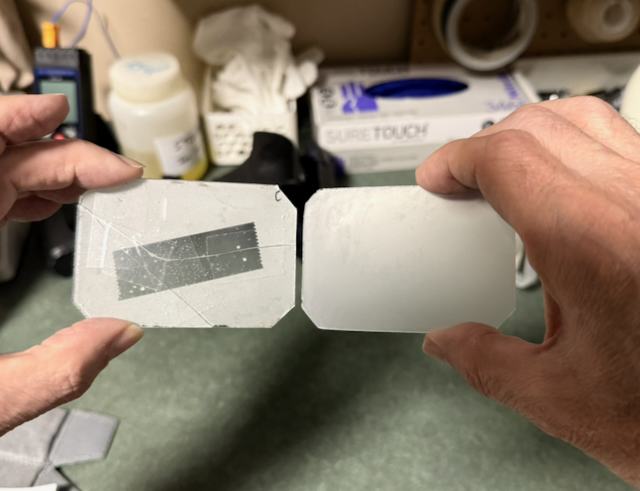
The grinding continues until the surface is perfectly even and the new glass takes on a translucency that matches the original.
IMG

Now lets try it out

IMG

Yes — the image is supposed to be inverted. This is how photographers see the world on these vintage cameras: upside down and reversed. What matters is that the new glass is bright, and the focus snaps in cleanly.

With that, the 1939 Baby Graflex can go back to doing what it was made to do: making beautifully sharp images.

And if you’re wondering about the name, “Baby Graflex” refers to the film size — 5×7 cm — compared to its big brother, the Graflex Speed Graphic, which shoots 10×12 cm film.
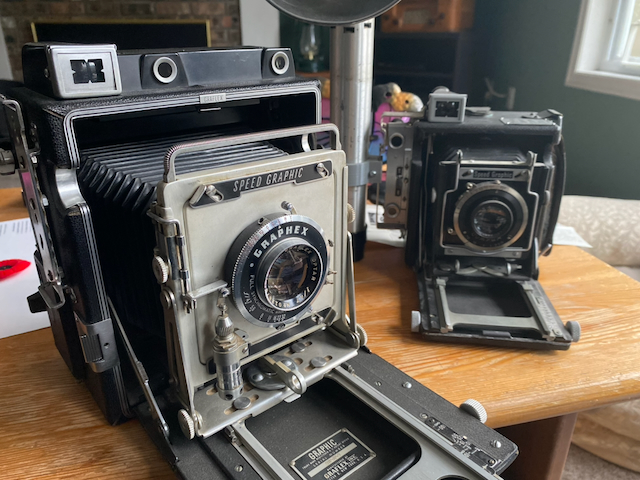
69967020136 0CE1657D 6A1E 4E72 B3FF BD93629EDB50

If you’ve ever wondered what it takes to keep these old cameras working, or you just enjoy seeing the inner life of a tool restored to purpose, this is a satisfying little journey.

Oskar Barnack:

A Tribute from the Workbench

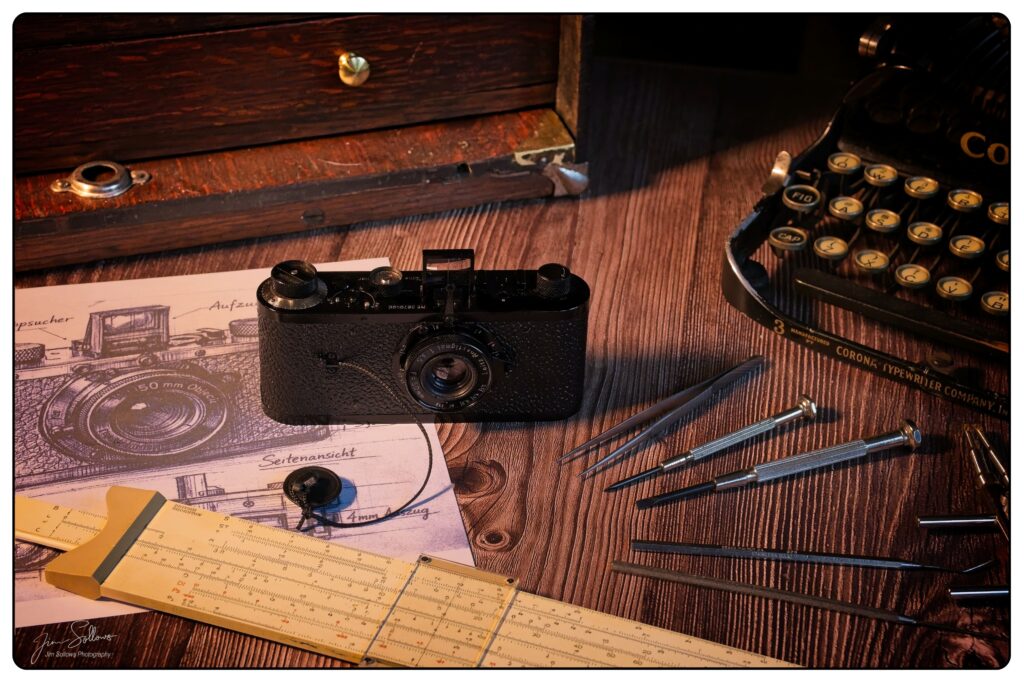
Oscar Barnack Workbench with Leica 0 Still Life

In the early years of photography, cameras were heavy, slow, and difficult to carry into the real world. For Oskar Barnack, an avid traveler whose health made carrying massive gear increasingly difficult, there had to be a better way.

Image
Oskar Barnack at his workbench

As a precision engineer at Ernst Leitz in Wetzlar, Barnack spent his days perfecting microscopes, but his side project was far more radical. He looked at 35mm movie film and had a stroke of genius: he turned the film on its side. By running it horizontally, he doubled the frame size to 24×36mm, creating the still-photo frame size that remains a standard to this day.

Barnack approached photography with the mind of a problem solver and the hands of a craftsman. In 1913, he built his first working prototype. He nicknamed it “Lilliput,” a nod to the tiny people of Gulliver’s Travels, because compared to the giant plate cameras of the era, his invention seemed impossibly small. He worked closely with Max Berek, Leitz’s lens expert, to ensure that the tiny negatives could be enlarged into sharp prints. This was the birth of modern handheld photography.

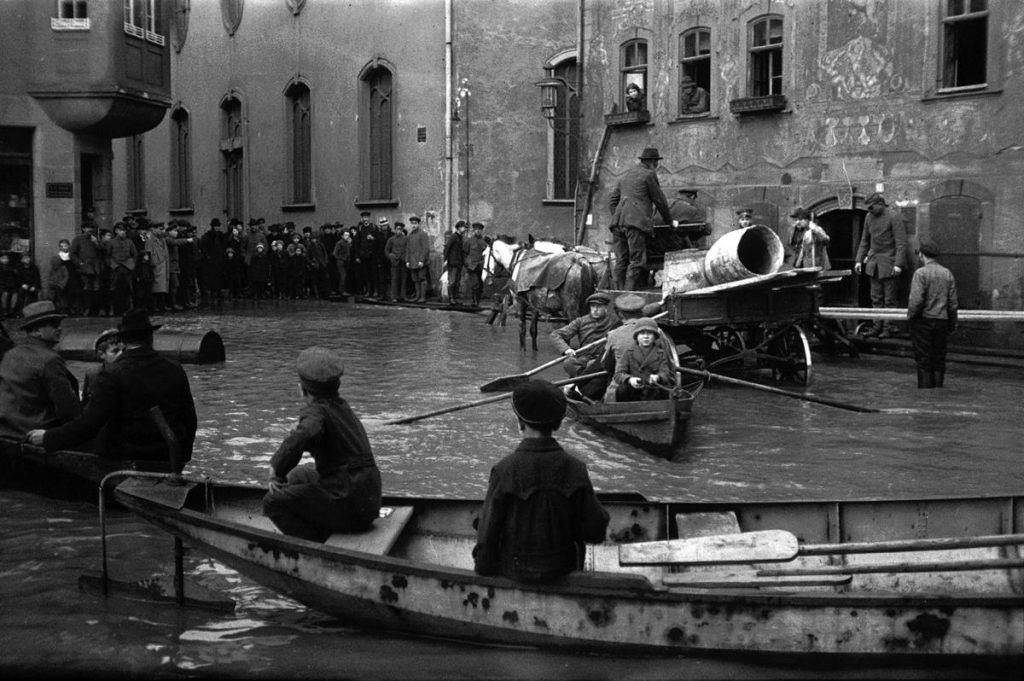
The true test came not in a laboratory, but in disaster. In 1913, severe flooding struck Wetzlar, and Barnack used his small prototype to document the devastation. While others struggled with bulky equipment, he was able to move freely through the streets, capturing scenes that would have been nearly impossible with the cameras of the day. Those images proved that his little camera was not just clever engineering, but a practical tool for real life.

Flood in Wetzlar teaser 1200x800 1 1024x681
Wetzlar floods 1913 captured by Barnack with his early prototype

However, an invention needs a champion. His boss, Ernst Leitz, was a visionary who recognized the potential of the “Lilliput” and even took a prototype to New York in 1914 to test it himself, photographing the city’s skyscraper canyons.

The First World War delayed production for a decade, and by 1924, Germany was in economic ruin. Most of Leitz’s advisors told him to kill the project, fearing it was too risky to launch a new camera format during a depression. But Leitz saw a way to keep his factory workers employed and change the world. In a legendary board meeting, he ended the debate with one sentence:

“Ich entscheide hiermit: Es wird riskiert.”
(“I hereby decide: the risk will be taken.”)

Oscar Barnack Workbench with Leica 0 Still Life
Still life remembering Oscar Barnack Workbench and his prototype Leica 0

With the decision made to go to market, the “Lilliput” needed a professional name. They combined the first three letters of the owner’s name (Leitz) with the first two letters of the word camera. And just like that, the Leica was born.

When the Leica I finally reached the public in 1925, it changed the direction of photography forever. Photojournalists and everyday storytellers finally had the freedom Barnack had imagined at his workbench.

The image above is my tribute to that moment. The Leica 0 sits on a blueprint that echoes the engineering sketches of the prototype camera design. The tools surrounding it reflect the world Barnack and Leitz inhabited—a world where precision and imagination worked side by side.

Barnack didn’t just design a camera, and Leitz wasn’t merely a businessman. Together, they created a tool that sparked a revolution in photography. Every shutter click carries a trace of their original vision.

In the beginning

… the Leica 0

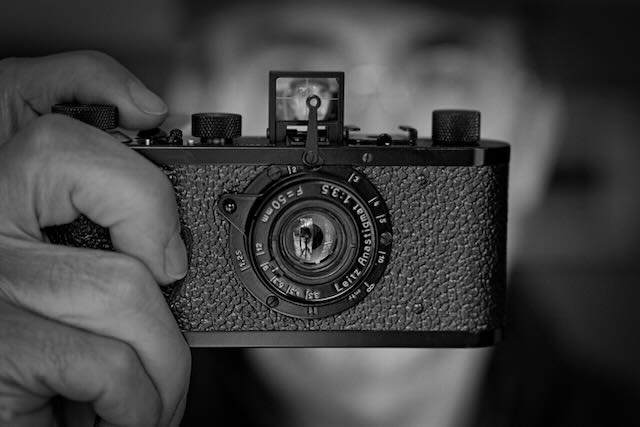
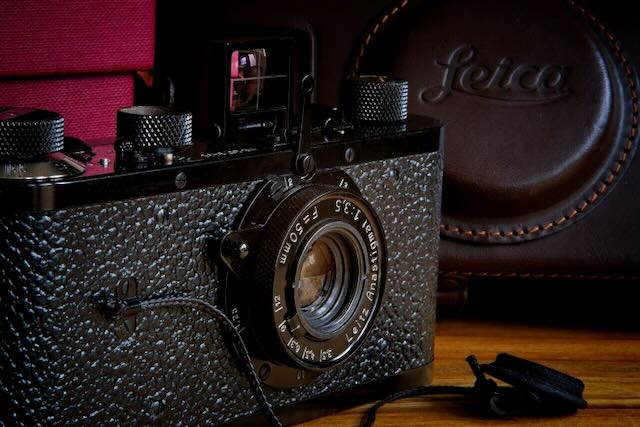
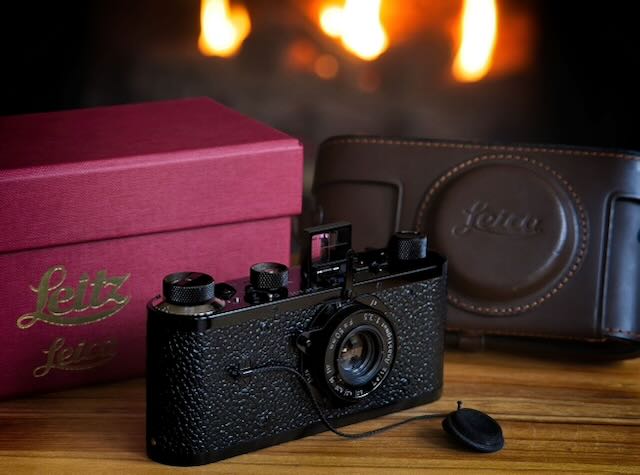
1923 Leica 0 a surprise Christmas gift from Shari

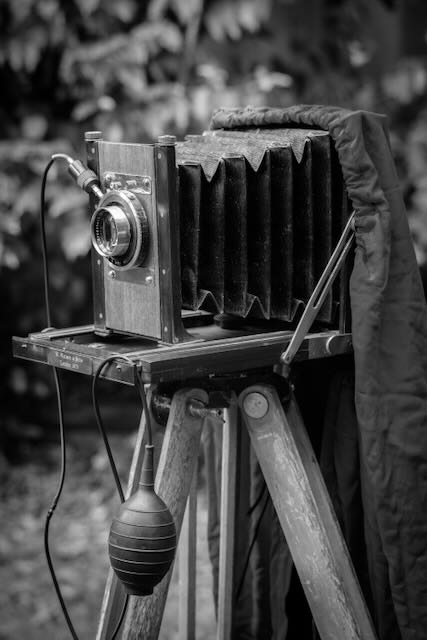
In the early 1920s, photography was slow and cumbersome. Most cameras were big, heavy wooden boxes mounted on tripods. Film handling was awkward, exposures were deliberate, and spontaneity was rare. Making a photograph required planning and patience.

DSCF9797
Watson & Sons is an example of a camera prior to the Leica 0

Then in 1923 a small experimental camera quietly changed everything. The Leica 0 began as a personal solution. Oskar Barnack was an engineer at the optical instruments company owned by Ernst Leitz. He struggled with asthma and found the heavy cameras of the day difficult to carry. A traveler and outdoorsman, he wanted a camera that could move with him rather than slow him down. His idea was radical for its time: use 35mm motion picture film horizontally to create a 24×36mm negative with excellent image quality in a compact body. Leitz supported the concept by helping finance the research and development of both the camera and a new type of film and canister to support it. That is the same 35mm film format and canister still in use today.

Many doubted that photographers would accept such a small negative. Large formats were considered essential for quality. But Ernst Leitz trusted Barnack’s engineering instincts and supported years of testing and refinement. The Leica 0 was built to answer a simple question: could this new approach work outside the workshop?

1923 Leica 0 a surprise Christmas gift from Shari
The Leica 0 uses a 50mm Leica Anastigmat lens

The answer reshaped photography. The Leica was born, cameras became portable, photographers became mobile, and images became more immediate. Candid moments, street work, travel photography, and modern visual storytelling all grew from this shift.

Look at the camera you use today, film or digital. Its lineage traces back to this quiet experiment — the Leica 0, where modern photography truly began.

1923 Leica 0 a surprise Christmas gift from Shari
Leica 0 a surprise Christmas gift

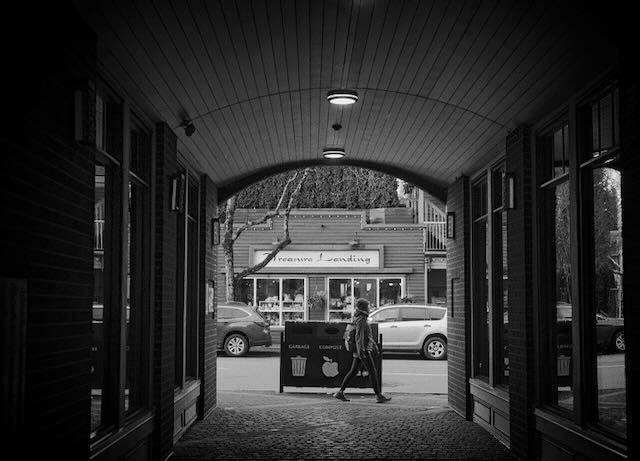
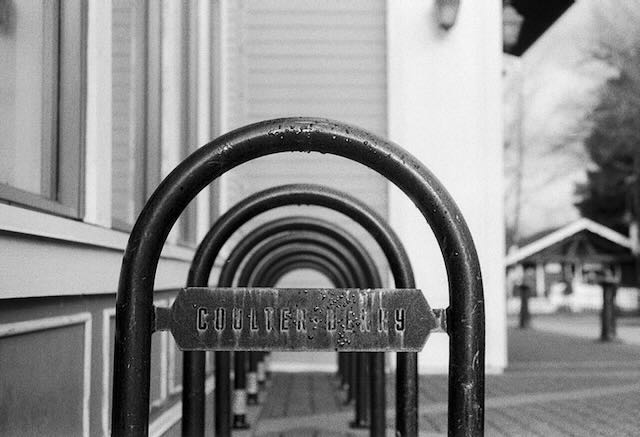
The Leica 0 in this photo was an unexpected gift from my wife this Christmas. It’s far more than a collector’s piece. It’s a piece of photographic history that changed how we see the world. My Leica 0 won’t be sitting on a shelf; it’s loaded with 35mm film. I’ve included a couple of the first frames I made in my eagerness to get out and shoot with this lovely, and very challenging, piece of history.

Test roll through the new Leica 0 with Ilford HP5
In the Village – Leica 0 on Ilford HP5
Sample photo shot with the Leica 0 on Ilford HP5
Bike rack on a wet day – Leica 0 on Ilford HP5
DSCF5765.RAF Export
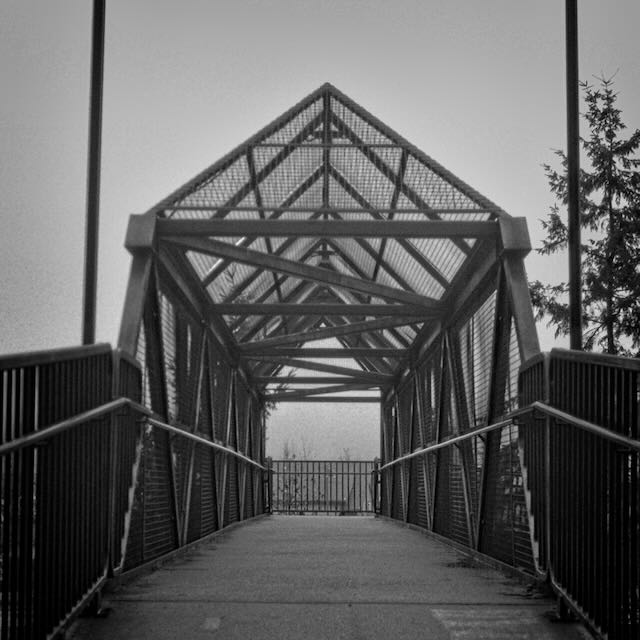
Pedestrian bridge in the fog – Leica 0 on Ilford HP5
DSCF5769.RAF Export
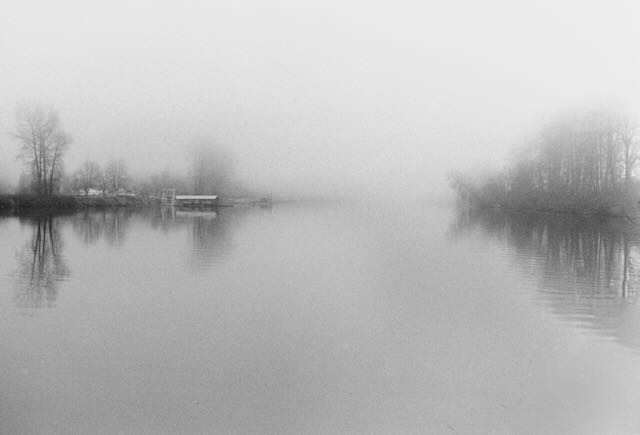
Foggy Morning Bedford Channel – Leica 0 with Ilford HP5

Leica re‑issued this Leica 0 in 2000 as a fully functional tribute to the 1923 prototypes, marking the 75th anniversary of the company’s first production camera. Limited to just 2,000 units, the camera was hand built from the original design to faithfully recreate the look and operation of the original Leica 0, of which only 25 were ever built and just a handful survive today. Those surviving originals routinely sell for many million dollars at auction, underscoring their status as some of the rarest and most historically important cameras ever made. The 2000 re‑issue offered photographers and collectors a way to experience Oskar Barnack’s pioneering history making design.