New Service Announcement

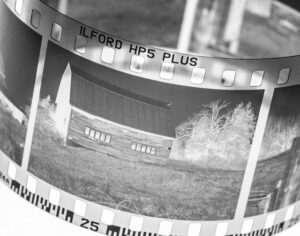
I’m excited to announce our new Black and White Film Developing service here in Fort Langley
IMG

If you have been shooting black and white film in the Fraser Valley, you already know the challenge. Colour film is easy because several local retailers will take it. Black and white is different. Most of the time your roll gets shipped off to a custom lab in Vancouver. It is slow, it is expensive, and your film disappears into a system where you never quite know who is handling it.

I have heard the same story from photographers again and again.

“I love shooting B/W, but getting it developed is such a hassle.”


So I decided to do something about it.

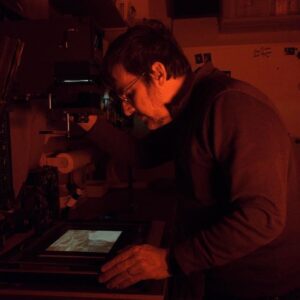
I am excited to offer black and white film developing right here in Fort Langley. Everything is done by hand in a professional darkroom with the same care and attention I have brought to film for more than fifty years.

Every roll is processed individually by hand, no shortcuts. Just traditional darkroom technique, controlled chemistry, and the kind of consistency that comes from experience.

Whether you shoot 35mm, 120, or 4×5 large format, I can process it. I also handle vintage, expired, and unusual film sizes using tray or dip and dunk methods. These are the same techniques photographers used long before minilabs existed.
DSCF1009 Export

Fast Turnaround and High Quality Scans

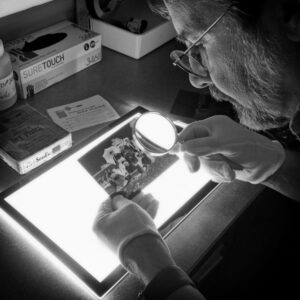
Unless you request develop only service, your film is scanned and delivered electronically in JPEG or TIFF format. Standard scans are 4000×3000. High resolution and wet scanning options are available for photographers who want every last bit of detail.

Negatives are sleeved and ready for pickup. I aim for a 24 to 48 hour turnaround depending on workload.

Why I Am Offering This

Film photography is alive and well in our community. I see it every day. People walking around Fort Langley with old Nikons, Hasselblads, and Pentaxes. Students discovering film for the first time. Parents dusting off cameras they inherited. Artists returning to the slower and more deliberate pace of analog.

But the infrastructure has not kept up. Black and white film deserves better than being shipped across the region for processing.

This service is my way of keeping the craft alive locally. It makes film developing easier, more accessible, and more personal for anyone who loves the look and feel of traditional photography.

How to Submit Your Film

If you would like to have film processed, contact me directly. I will provide the drop off location, the current turnaround time, and a simple order form to include with your rolls.

Mail in service is also available for photographers across Canada.
Darkroom jim

A Final Thought

Black and white film has a magic all its own. It is timeless, expressive, and honest. It rewards patience and intention. And it deserves to be handled with care.

I am looking forward to working with local photographers whether you are shooting your first roll or your thousandth. Keeping this beautiful medium alive in our corner of the Fraser Valley is something I am proud to support.

If you have questions or want to talk film, feel free to reach out. I am always happy to chat photography.

You can find more details on the Film Development section of our website.
1909 Kodak 3A a Second Chance

A 117 Year Old Camera, a Roll of Expired Film, and a Second Chance

Kodak 3a from
Kodak 3a from 1909

Every now and then an email lands in your inbox that makes you stop what you are doing. A few months back, a family reached out after cleaning out their attic. They had found an old camera, and not the charming kind of old. This one looked like it was destined for the local landfill. It was a mildew covered box that creaked when they tried to open it. They were ready to throw it out but hesitated. Maybe someone might want it. They did some digging online and found a few news stories and articles that led to me. They reached out, and eventually the camera ended up on my workbench.

It turned out to be a Kodak 3A from around 1909, but it had seen better days. In fact, I regretfully did not even bother to take before photos because everything about it suggested a lost cause.

A Camera Built for Postcards

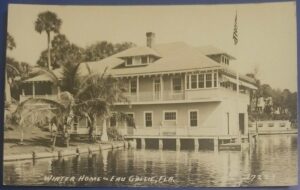
The Kodak 3A is a funny piece of history. Kodak introduced it in 1903 and kept it around until the early 1910s. Its whole purpose was simple and clever. It was designed to make postcard sized negatives. Kodak sold paper that was light sensitive on one side and pre printed as a postcard on the other. You could shoot, develop, contact print, and mail your own postcards. No enlarger needed and no complicated darkroom work.

Postcard1


It was not a camera for photographers. It was a camera for people. Travellers, explorers, business folks on the road. A close cousin of this model even made it to the South Pole with the Scott Amundsen expeditions.

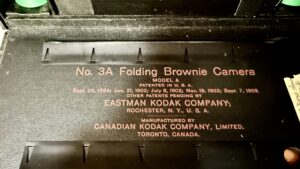
This one carries patent dates up to 1909, so that is what I am calling it. A 1909 survivor.

IMG


The Restoration

When it arrived on my bench, it looked tired, and that is being kind. The leather case was covered in green mildew. The aperture blades were stuck. The shutter barely moved. The leather bellows was black with dirt and felt like old cardboard that might break if you breathed on it. Everything needed attention.

The first question with any folding camera is the bellows. If they are full of pinholes, you are in for a long week. Despite the grime, I could not see anything obvious, so I brought it into the darkroom, put a light inside, closed it up, and checked. It was actually light tight. That was the moment I knew this camera was not done yet.

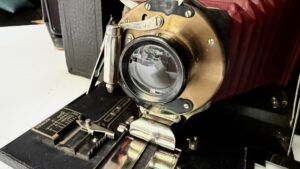
From there it was a full teardown. The shutter came apart. The ancient oil, now closer to glue, was cleaned out. The bellows got a careful treatment with saddle soap, conditioner, and many hours of work. The brass came back to life. The lens cleared beautifully. Even the tiny viewfinder cleaned up.

IMG


When I put the shutter on the tester afterward, it ran at 1/25 of a second. Exactly the way it left the assembly line in 1909.

The Film Problem

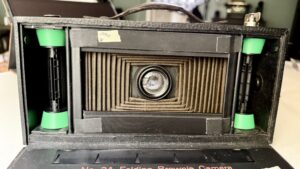
There was still one problem to solve. The Kodak 3A was built for 122 film, a format that has not existed for decades. Modern 120 film is easy to get, but it is too small. The spools do not fit and the film will not sit flat.

I designed and 3D printed spool reducers and a set of guide rails to keep the film aligned. With 120 loaded, the camera shoots a panoramic 6 by 14 centimetre frame. It is a monster of a negative.

IMG


Loading the Most Interesting Film I Could Find

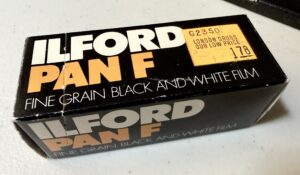
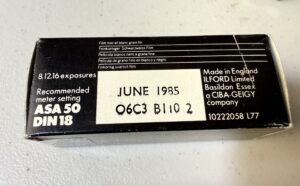
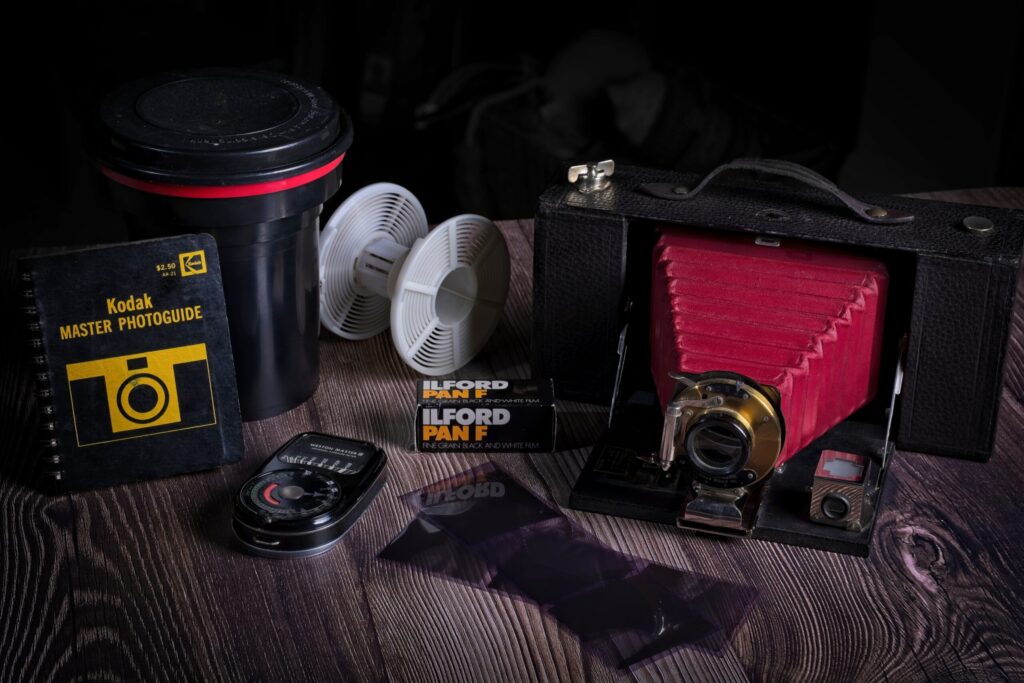
Fresh film would have been the sensible choice. Sensible is not always fun. Instead, I loaded a roll of Ilford Pan F that expired in 1985. It had definitely not been refrigerated for most of its life. Pan F is gorgeous when fresh, but at nearly forty years past its date, I rated it at ISO 20 to give it a fighting chance.

IMG
IMG


Whether it would give me images or heartbreak, I had no idea.

Out to Pitt Lake

Pitt Lake is one of my favourite places to shoot. Over one thousand square kilometres of pure wilderness and only minutes from my door. It was the perfect place for a panoramic camera, even one that is more than a century old.

I set up the camera on a tripod and metered the scene. Aperture at f/11. Fire the shutter. Five half turns of the crank. Bracket at f/16. Repeat.

Five exposures per roll. That is all you get.

Back in the Darkroom

With expired film, especially film this expired, development becomes a negotiation. I went with semi stand development in Rodinal 1 to 100. A little agitation at the start, then let the chemistry do what it wants. Come back at 30 minutes, agitate again, leave it another 30.

It is a forgiving process. Perfect for film that has had a rough life.

Then the lights went out, the film went into the tank, and I waited.

The Results

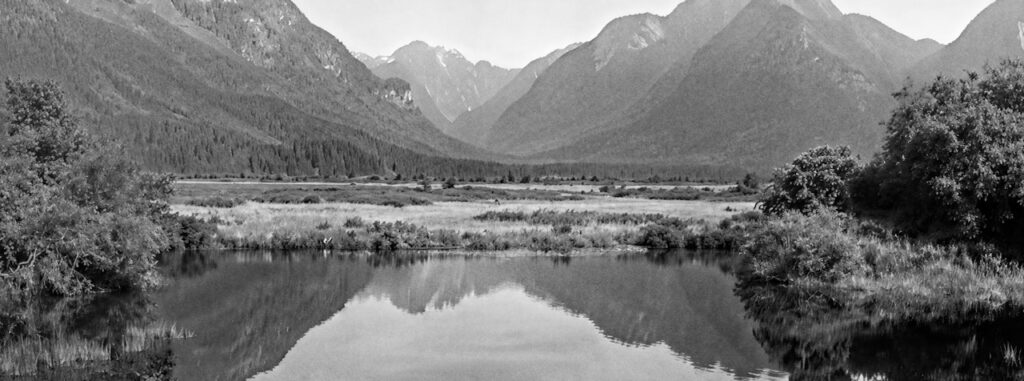
The negatives are enormous, and honestly, they are beautiful.

The lens has that early twentieth century look. Sharp in the centre, gentle at the edges. The expired Pan F gave a soft, luminous contrast that suits Pitt Lake perfectly. For a camera that was almost thrown away, the images feel like a small miracle.

20260522 Kodak 3a Ilford FP4 1985 1 RestoreAI


There was one issue. Frame spacing. Because 120 is smaller than 122, the red window on the back is useless. I counted crank turns instead. It worked for the first couple of frames, then drifted. Images on one end overlapped. Without frame numbers on the old film it was hard to tell whether the frames at the beginning or the end were off.

In hindsight, it is obvious. As the take up spool grows, each turn moves more film than when the spool is small. Next time, and there will be a next time, I will adjust the turn count as I go. More experimentation will help to nail that down, but at least I know the camera works beautifully.

117 Years

This camera was built around 1909. It made postcards for travellers and families, then vanished into storage, then into an attic, and nearly into the landfill.

But it survived. It came back to life on my bench. It made new photographs at Pitt Lake. It proved it still had something left to give.

Not many things last 117 years. Even fewer get a second chance. This one did, and I am glad I was there when it asked for it.

Bringing it back reminded me why I love this work. Old cameras are more than tools. They are stories waiting for someone to turn the page.

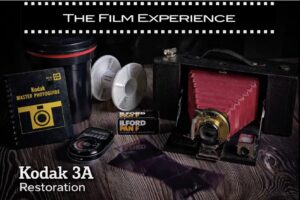
If you want to see the full restoration, the field test, and the darkroom results, the video is up on The Film Experience on YouTube, and more is at sollows.ca.

Screenshot 2026 06 16 at 12.28.40 PM